UNCRPD - Convention on the Rights of Persons with Disabilities
On 13 December 2006, the United Nations (UN) General Assembly adopted the text of the Convention on the Rights of Persons with Disabilities (UNCRPD).
On 30 July 2007, the European Union (EU) signed the UNCRPD. This was the first time the EU had signed a UN convention.
On 2 July 2009, Belgium finally officially ratified the UNCRPD (this means that Belgium must bring all its legislation into line with the UNCRPD) and the accompanying ‘Optional Protocol’ (this means that individuals or groups of individuals have the right to submit a petition to the Committee on the Rights of Persons with Disabilities).
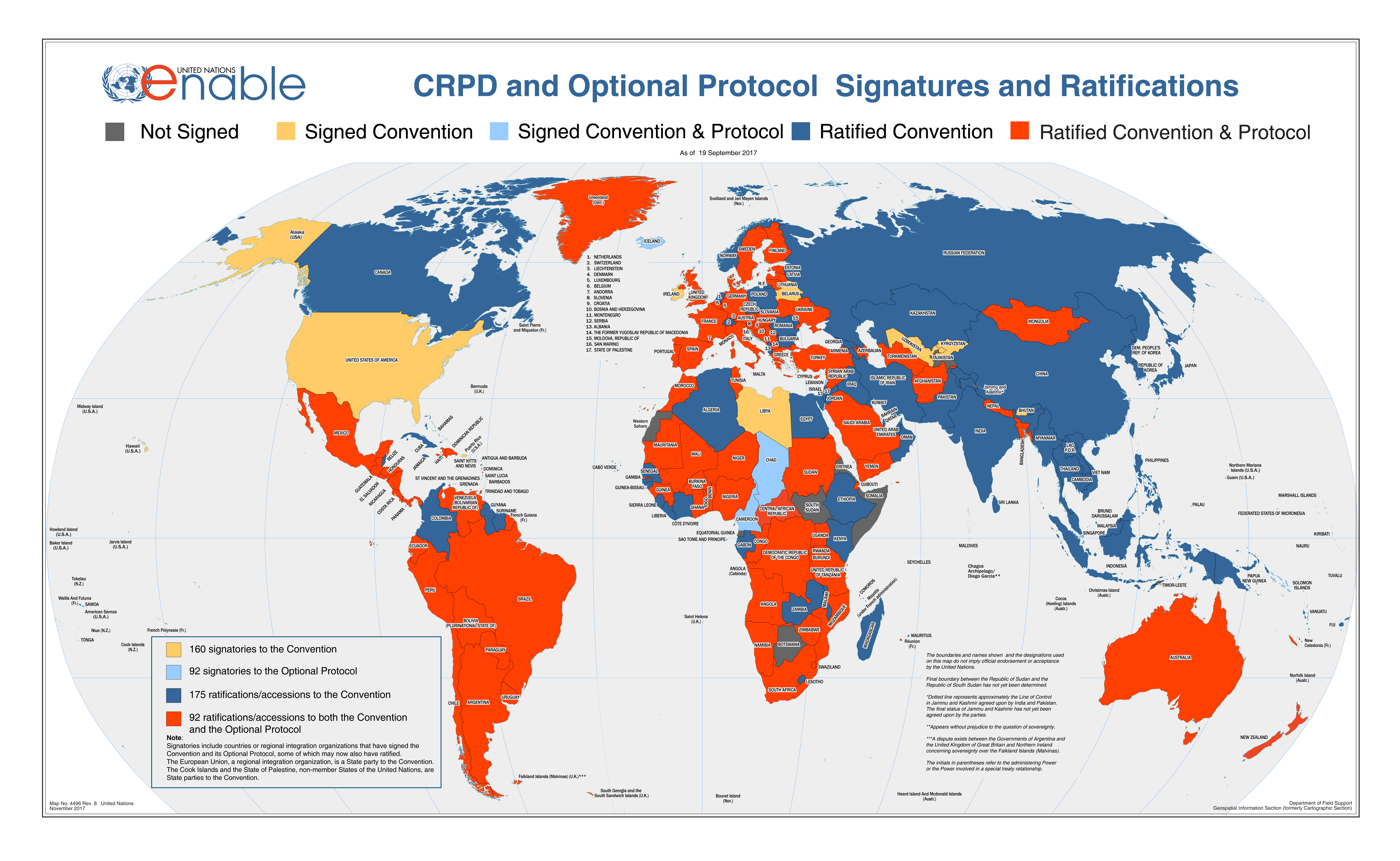
Click here for an overview of the countries that have signed and/or ratified the UNCRPD.
The Convention aims to ensure that persons with disabilities enjoy the same human rights as everyone else and that they can participate fully in society by being given the same opportunities as everyone else. The Convention covers a wide range of areas, including: health, education, employment, access to justice, freedom of choice and independent living, accessibility, etc.
The Committee on the Rights of Persons with Disabilities (UNCRPD Committee) monitors compliance with the Convention and also regularly issues authoritative interpretations of certain articles through general comments.
States Parties to the UNCRPD are assessed in an evaluation cycle:
- State report + alternative reports from civil society
First, the situation in the country is examined on the basis of the official State report and the alternative reports from civil society. The monitoring committee for the alternative reports for Belgium comprises, amongst others, representatives of the organisations that are members of the BDF and of the advisory councils for persons with disabilities at federal and regional government level. - List of issues from the UNCRPD Committee
The UNCRPD Committee then draws up a list of issues reflecting the concerns of civil society as expressed in the alternative reports. - Written response from the State concerned + interactive dialogue between the State and the UNCRPD Committee
The State Party then has some time to respond. Each year, a number of countries are subsequently invited to a meeting with the UNCRPD Committee in Geneva, where the state of play regarding the issues previously raised is often reviewed. - Concluding observations of the UNCRPD Committee
Finally, the UNCRPD Committee adopts its concluding observations. The next review cycle then begins with the implementation of these concluding observations.
UNCRPD in Belgium
- 3rd alternative report by the BDF - UNCRPD (12/07/2024)
- Summary of the 3rd alternative report by the BDF - UNCRPD (12/09/2024)
Further information:
-
Beijing Declaration and Platform for Action
-
UPR - Universal Periodic Review
-
SDGs - Sustainable Development Goals
-
CRC - Convention on the Rights of the Child
-
ICESCR - International Covenant on Economic, Social and Cultural Rights
-
CEDAW - Convention on the Elimination of All Forms of Discrimination against Women
-
CAT - Convention against Torture and Other Cruel, Inhuman or Degrading Treatment or Punishment
-
ICCPR - International Covenant on Civil and Political Rights
United Nations
-
Beijing Declaration and Platform for Action
-
UPR - Universal Periodic Review
-
SDGs - Sustainable Development Goals
-
CRC - Convention on the Rights of the Child
-
ICESCR - International Covenant on Economic, Social and Cultural Rights
-
CEDAW - Convention on the Elimination of All Forms of Discrimination against Women
-
CAT - Convention against Torture and Other Cruel, Inhuman or Degrading Treatment or Punishment
-
ICCPR - International Covenant on Civil and Political Rights